Read the full blog on socialprotection.org
Investing in social protection is essential to reducing poverty, strengthening resilience, and expanding opportunities for people facing vulnerability. Across ASEAN, governments have made major investments in social protection, livelihoods, and other services that have helped drive remarkable progress in reducing poverty.
However, for households in extreme poverty who face multiple barriers at once, these investments can be strengthened further when social protection, livelihoods, coaching, and other services work together around the needs of the same household. But these gains raise a new policy question: How can systems designed to protect households from hardship also help them build more secure and productive livelihoods? ASEAN governments can build on major gains in poverty reduction by connecting social assistance more closely with livelihoods and economic resilience.
Graduation is one approach that combines the ABCs (Assets, Basic Needs support, and Coaching) to help households build resilience and move out of extreme poverty. This blog examines how Graduation can support ASEAN member states' existing social protection efforts to further advance their progress and support more durable pathways out of extreme poverty.
A changing poverty challenge
ASEAN’s progress in reducing poverty has transformed millions of lives. The scale of that progress is remarkable. Indonesia reduced poverty by more than 80 percent between the mid-1970s and mid-1990s. Vietnam’s multidimensional poverty rate is now below 1 percent. In the Philippines, the national poverty rate fell from 23.5 percent in 2015 to 15.5 percent in 2023, despite a major setback during the COVID-19 pandemic.
The households that remain in the deepest forms of poverty often face several disadvantages at the same time. Their work may be informal, seasonal, or poorly paid. They may lack productive assets, savings, market connections, documentation, or reliable access to public services. Women frequently face additional constraints from unpaid care work responsibilities and limited mobility, and they are more likely to be in unpaid or low-paid work. These vulnerabilities are increasingly compounded by climate shocks, which can destroy productive assets, disrupt already-fragile livelihoods, and push households back into poverty.
Because these barriers reinforce one another, access to a single programme may not be enough.
A cash transfer can help a family maintain food consumption and keep children in school, but it may not create a durable source of earnings. A livelihood grant can provide an asset or working capital, but its impact may be limited if the recipient lacks skills, savings, market access, or support to respond to setbacks. Training may be difficult to use when a household cannot afford to step away from daily work.
The issue is therefore not simply whether social protection, skills, livelihood, and financial inclusion programmes exist. It is whether they work together in ways that reflect how households actually build economic security.
ASEAN countries have already developed much of the necessary infrastructure. The Philippines’ Pantawid Pamilyang Pilipino Program, or 4Ps, reaches more than four million households. Indonesia’s Program Keluarga Harapan, or PKH, reaches approximately ten million beneficiary families. Governments across the region also operate livelihood schemes, food assistance, health insurance, training programmes, and local social services.
Yet these interventions often sit in different institutions, with separate budgets, beneficiary lists, timetables, and objectives. A household may receive one form of assistance without gaining access to the complementary support needed to translate temporary stability into sustained income growth.
The opportunity is to strengthen coordination so existing public investments work more effectively together for households.
Graduation as one practical approach
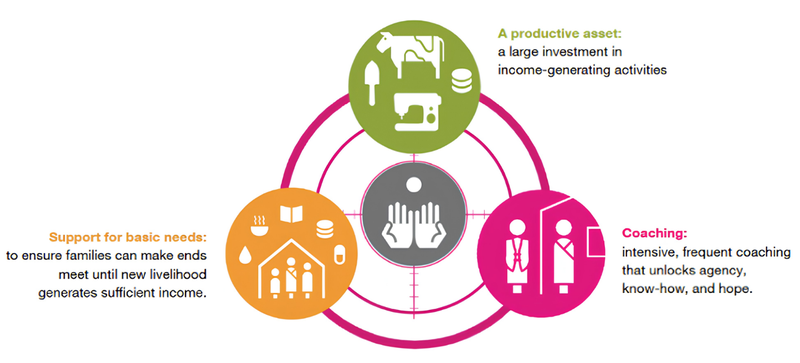
The Graduation approach offers one way to address this challenge.
Graduation is a time-bound, multi-component approach designed for households facing several barriers simultaneously. Its core elements typically include temporary support for basic needs, a productive asset or seed capital, and sustained coaching and skills development. Programmes may also connect participants to savings, financial services, health and social services, and markets.
Graduation is not intended to replace cash transfers or existing livelihood programmes. It can instead help governments organize these different forms of support around the needs and economic trajectory of the same household. It can also strengthen households’ resilience to shocks, for example through diversified and climate-resilient livelihoods, stronger savings and assets, and coaching that helps participants anticipate and respond to climate risks.
There is no single institutional model. Governments can add Graduation components to an established social protection or livelihood programme, coordinate several existing programmes into a common package, or create a dedicated intervention where important services are missing.
The Philippines and Indonesia illustrate how this principle can be adapted to different government systems.
The Philippines: learning from a government pilot
From 2018 to 2021, a Graduation pilot in Negros Occidental selected participants from the Philippine government’s 4Ps cash-transfer programme. The Department of Labor and Employment’s existing Kabuhayan livelihood assistance was complemented by coaching, skills training, and support for savings.
The results were promising. Participating households experienced higher consumption, stronger food security, increases in productive assets, and higher savings rates. The evaluation also found that group-based coaching reduced programme costs by 27 to 32 percent without a significant decline in impact.
BRAC Philippines is now working with government partners to build on these lessons and explore how stronger links between social protection and livelihoods can work at scale.
Indonesia: allowing different local models to emerge
Indonesia is pursuing the same broad objective through a different institutional route. With technical support from BRAC, national and subnational governments are developing Graduation models that can fit within Indonesia’s existing poverty-reduction architecture. The approach has been incorporated into development plans and strategic policy frameworks, with an ambition to reach at least one million households by 2029.
In West Nusa Tenggara, the provincial government launched a standalone Graduation-style programme in late 2025. Nearly 150 coaches were recruited to support participant selection and programme delivery for the first cohort, which reached 7,250 households. The programme is planned to scale up progressively, with coverage expected to reach approximately 33,000 households by 2028.
Other provinces may adopt a different model, combining existing social protection, livelihood, and local development programmes rather than creating a new programme.
A regional agenda for learning
The Philippine and Indonesian experiences are different, but they point toward a common principle: poverty policy should be assessed not only by the reach of individual programmes, but by whether the public system as a whole helps families build more secure and productive lives.
Progress may come through shared targeting, better referral systems, coordinated delivery schedules, better data sharing, or joint case management.
The ASEAN Community Vision 2045 creates an opportunity for countries to learn from one another as they test different approaches. The aim should not be to develop a uniform regional programme, but to learn what works under different institutional and economic conditions.
We propose three priorities:
- Strengthen national connections between social protection and resilient livelihoods: Governments can examine how existing social protection, livelihood, skills, and other programmes can better connect, reach, and support the same households.
- Build a regional learning agenda on integrated poverty eradication: ASEAN can help countries exchange practical lessons on programme design, coordination, targeting, and implementation as different approaches are tested.
- Support country-led adaptation and evidence-building: Governments and development partners can test approaches suited to national and local systems, generate evidence on what works, and use those lessons to improve programmes over time.
ASEAN has already demonstrated what sustained growth, public investment, and political commitment can accomplish. The next step is to make sure these investments work together so households facing the greatest barriers can move toward more secure and sustainable livelihoods.
Read more in BRAC’s recently launched policy brief: “Reducing Extreme Poverty and Advancing Inclusive Social Protection in ASEAN”.
This is the second blog in the series The Cost of Not Investing in Social Protection, part of socialprotection.org’s 11th anniversary campaign. The series brings together contributions from the USP2030 Working Groups and other invited authors, combining broader reflections on financing social protection with discussions examining the costs of underinvestment across key cross-cutting areas, including gender and inclusion, climate and crises, digital transformation, and food security. Together, the contributions highlight the human, social, and economic consequences of insufficient investment and reinforce the campaign’s central message: the greater cost lies in failing to invest in social protection.