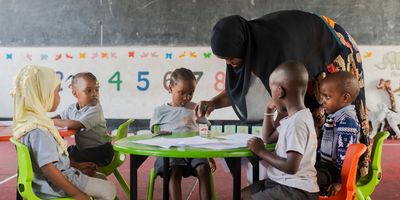
Every morning across Dar es Salaam, the Angaza Learning Centres fill with the sounds of little children arriving, laughing and ready to play. Behind these colourful centres are its caregivers, who came to the classroom through very different routes. Some always knew they wanted to teach. Others found teaching by accident.
Meet 27-year-old Bahita Kakuru, who has always wanted to teach since she was a girl, and 39-year-old Dogo John Ponera who came to teaching by accident and fell in love with it.
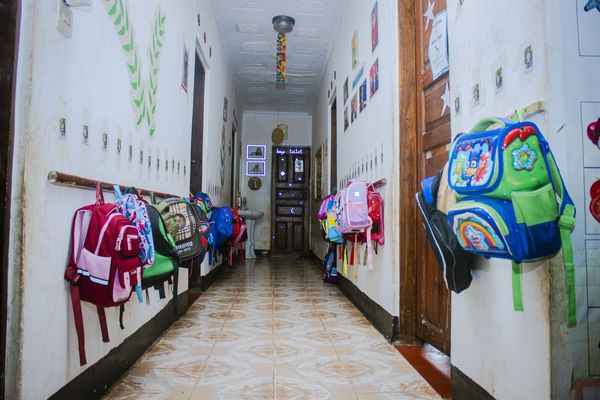
More than 16 million children in Tanzania are under 8, around a quarter of the population. These years lay the foundation for lifelong health, learning and wellbeing.
Tanzania has made important progress in expanding access to education, including through fee-free public education. But access alone is not enough. UNICEF data shows that only 47.4% of children aged 2–5 are developmentally on track in health, learning and psychosocial wellbeing — meaning more than half are already falling behind before they reach primary school.
To support the government's agenda to expand access to quality childcare, strengthen early childhood development and enable women’s economic participation, Angaza Learning Centre, a social franchise model under BRAC Enterprises Tanzania Limited, brings access to quality early childhood education. Based on BRAC’s globally recognised play-based curriculum, the model uses internationally recognised tools to track learning, care quality and child development outcomes.
At the heart of the model are women caregivers, trained to set up and run their own centres as Angaza partners. They hire and train further caregivers and assistant caregivers, and those who build enough experience can open centres of their own. Today, 9 trained partners run 12 Angaza Learning Centres across Dar es Salaam.
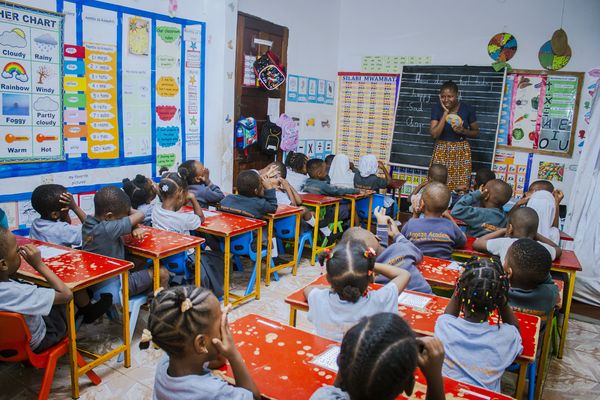
Dogo John Ponera, a mother of two sons, never saw herself become a teacher. She fondly recalls growing up in her grandparents’ home, a big household of uncles, aunts and their children. Evenings were playful, full of rhymes, songs and homework shared with cousins.
“After my O levels, my mother got me admitted into a teacher’s training college. I didn’t go. I wanted to be an entrepreneur like my grandfather. He was an inspiration to me," she shared.
In 2016, Dogo met a BRAC staff member who was surveying to recruit play leaders for an early childhood development project. With encouragement from her mother and husband, she applied for the position. Two months later, she found herself outside the interview room, nervous. She was asked to sing rhymes. Dogo looked back to her childhood and sang just like she did with her cousins. She also made the interview panel recite and dance with her, and left the room knowing that she was selected.
After two weeks of intensive training, she was ready to lead a play lab. With support from BRAC, she found a place and set it up, ensuring it was a safe and inviting space for children. A staff member monitored and guided her throughout the process. Soon she was managing a group of 28 children, all from her community.
The play lab was then run by BRAC and funded by the LEGO Foundation. In 2019, the programme's funding ended. Dogo decided to take on managing the play lab by herself. By that time, she had trained and hired assistant caregivers. She took on the costs of paying rent and caregivers’ salaries. Her play lab had 81 learners in three rooms. She however, had to close it down when COVID-19 hit in 2020.
Looking at Dogo’s exceptional performance, BRAC asked her to join as a caregiver at the Angaza Learning Centre. Seeing a better opportunity, Dogo signed the contract, letting the assistant caregivers run her play lab, which resumed post-pandemic on parent’s demand.
Today, Dogo has moved on from a caregiver to an Angaza partner, running two centres on her own, one with 104 children and the other with 60. She is leading a team of four caregivers and three assistant caregivers, recruited and trained all by herself.
In 2025, 82% of Angaza learners met their developmental targets, measured using BRAC’s skills assessment tool, adapted from the internationally recognised IDELA framework. Caregivers receive training from BRAC Enterprises Tanzania Limited (BETL) and external institutions while classroom practice is regularly observed and coached using the BEQI tool, which assesses the quality of caregiver–child interactions, the learning environment and children’s engagement.
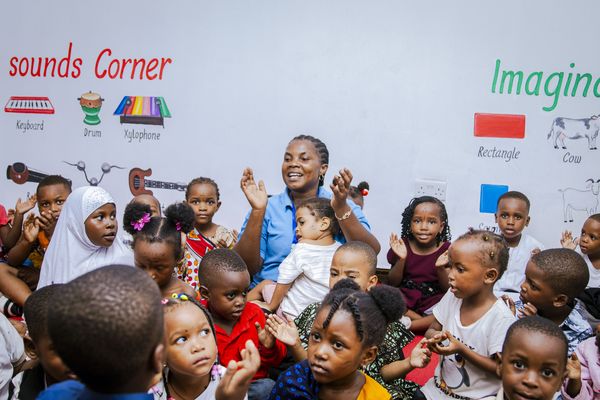
Bahita Kakuru always wanted to become a teacher.
She earned a bachelor's degree in early childhood education from the University of Dodoma.
In her final year, Bahita saw a job opening for an assistant caregiver. “It was my first ever interview, and I was so happy when I found out that I got the job,” she says. She started in July 2023, and in three months, was promoted to a caregiver.
Her centre had been part of BRAC’s earlier pilot, which eventually transitioned to the more affordable Angaza model. She started working with Frank, an Angaza partner, who had opened a new centre with no enrolment at all. Together, they would walk the streets, knock on doors and make announcements through microphones. Twenty-seven children came for enrolment on the first day. Today, the centre has 96 children, while 30 children have transitioned to primary school this year.
Bahita hopes to open her own centre and become an Angaza partner after a few years of experience.
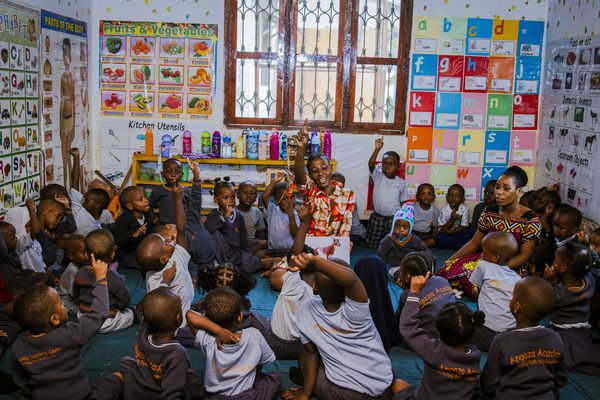
“Parents choose Angaza over other daycare centres for the curriculum and the quality. As caregivers, we keep learning too, through monthly training sessions,” says Bahita.
Dogo’s journey as an Angaza partner not only gave her family financial stability – both her sons go to English medium schools, something that was beyond Dogo’s belief just a few years back – it also gave her a new identity. “I found a strong voice to advocate for children’s education and the importance of girls staying in school.”
Dogo and Bahita have never worked together in the same centre. Bahita is early in her career and learning fast. Dogo sustained her play lab and now runs her own enterprise to shape the next generation of learners and caregivers.
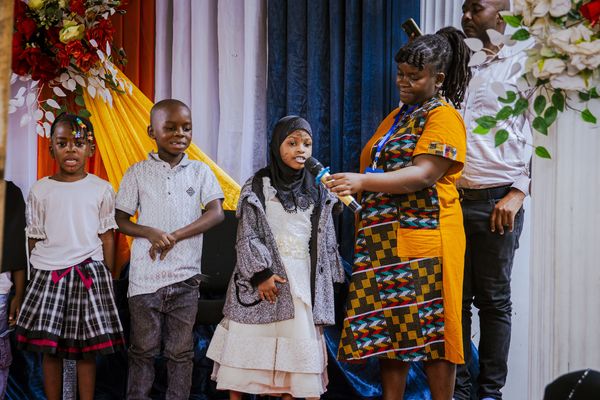
"It gives me immense pleasure to create opportunities for women who have the potential to become a partner tomorrow. Eventually I did become an entrepreneur," Dogo added.
Established in 2020, the Angaza Learning Centre is a social franchise model that engages women caregivers to set up financially viable early learning centres. Operated as independent businesses, each Angaza partner receives ongoing support from BRAC Enterprises Tanzania Limited to provide high-quality early childhood learning. Angaza partners can earn up to five times the income they would in the local market.
Currently 9 Angaza partners like Dogo are managing 12 Angaza Learning Centres with 34 trained caregivers and assistant caregivers like Bahita. To date, over 1,000 children have joined these learning centres, getting the right headstart before primary school.
Written by: Elizabeth Gupta, General Manager, BRAC Enterprises Tanzania Limited and Shituma Tajrin, Senior Manager, Programme Communications, BRAC International
Photo Credit: Daud Mohamed, Senior Communications Officer, BRAC Maendeleo Tanzania
Edited by: Sameeha Suraiya Choudhury, Lead, Strategic Content, BRAC International