In August 2017, almost a million Rohingya fled to Bangladesh from violence and persecution in Myanmar. Among them, 55% were children, many of whom were torn from their families, and had seen more violence than most adults would in a lifetime. For these children, displacement meant losing much more than a home. It meant leaving behind the language, friendships and the world they had always known. It meant losing a childhood that feels safe.
Half a world away, children growing up in the refugee settlements in Uganda now face the same challenges.
Children living in crisis in Uganda
Uganda is home to one of the world's largest refugee populations, hosting approximately 2.06 million refugees and asylum-seekers as of October 2026, around half of whom are children. Many have fled conflict in South Sudan, the Democratic Republic of the Congo and Sudan, arriving with diverse experiences, languages and needs.
When families are forced to leave their homes, the immediate priorities are clear: finding shelter, securing food, accessing healthcare and ensuring safety. For young children, however, other essential needs, such as safe spaces to play, learning and meaningful time with their parents and caregivers, can easily become secondary. This has lasting implications.
Meanwhile, growing humanitarian needs and declining international funding are putting considerable pressure on the provision of these services.
Uganda has made significant progress in prioritising early childhood development through its Early Childhood Care and Education Policy and National Child Policy. Yet, access to early learning remains uneven, particularly for families living in marginalised and remote communities. The country has one of the most progressive refugee policies in the world, including granting freedom of movement, land to cultivate, and the right to work and open a bank account. For children escaping trauma and conflict, the support must extend to quality early learning because it is what will guarantee a stronger future.
The role of play when childhood is disrupted
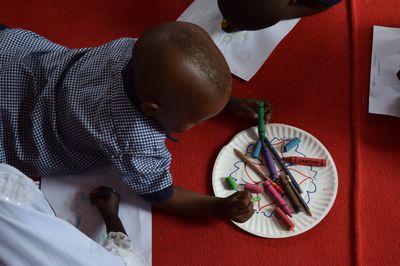
Play means something more for children living in crisis. It is a way to heal. Not having a safe and stimulating space may lead to a child becoming withdrawn and having difficulty interacting with others. Disruptions during these early years can affect their development and readiness to participate in formal education.
To protect the dignity of childhood for these children, it was important to build them a home away from home. This led to the development of BRAC's Humanitarian Play Lab model in 2018, designed and co-created with local communities in refugee settlements to meet the unique needs of children in crisis contexts, offering early childhood development, psychosocial support, and cultural preservation. It builds on BRAC’s flagship Play Lab model that prioritises learning through play, and is built on the evidence that play goes beyond just games and a good time.
Play is one of the most natural ways young children understand their surroundings. Through play-based learning, children develop communication skills, coordination, early mathematical thinking, problem-solving, and social skills. When they sort objects, tell stories, build structures or take turns in a game, they learn in the process.
In humanitarian settings, play can help restore a sense of familiarity and routine in environments where much has changed. It supports psychosocial wellbeing as children can better cope with fear, stress, and anxiety.
Bringing humanitarian play labs to Uganda
Taking the lessons from Bangladesh, BRAC began its early childhood work in refugee settlements in Uganda in 2020, setting up 10 humanitarian play labs in the Rhino refugee settlement.
The work expanded in 2022 through the Early Childhood and Graduation (ECG) project. Between 2022 and 2025, BRAC operated 84 Humanitarian Play Labs across Rhino and Imvepi refugee settlements, reaching approximately 5,000 children from refugee settlements and host communities.
The implementation places communities at the centre of delivery. Play leaders are selected from the communities and trained, based on their understanding of local languages, cultures and family circumstances. On the other hand, parents and caregivers contribute to making learning and play materials using locally available materials. They decorate and maintain the play labs, and attend parenting sessions. This community-led approach builds trust and makes the learning environment rooted to a child’s realities. It also encourages children from different backgrounds to play and learn together, strengthening social cohesion.
Beyond programme delivery, BRAC has been working with the Government of Uganda to strengthen the ECD sector since 2016. This includes engagement with the Ministry of Education and Sports, the Ministry of Gender, Labour and Social Development, and the Ministry of Health. BRAC serves as co-chair of the Network for Early Childhood Development Actors (NECDA) and participates in the Education in Emergencies Sector Working Group, sharing experiences with partners and policy makers.
BRAC's ECD curriculum, approved by Uganda’s National Curriculum Development Centre (NCDC), further supports alignment with national learning expectations, and provides a foundation for quality delivery and wider adoption.
The case for a two-generation approach for lasting impact
An important learning from BRAC's experience working in the humanitarian context is that children’s development cannot be separated from the circumstances of the adults caring for them.
A child may have the opportunity to enrol in a well-supported, safe, nurturing space, but the benefits are difficult to sustain if their homes are threatened by uncertainty, facing food insecurity or unstable income. Similarly, improving a family's financial circumstances does not automatically translate into better outcomes for children unless caregivers have the knowledge, time, and support to provide nurturing care.
To ensure sustainable impact on both levels, BRAC designed a two-generation approach combining its early childhood development and ultra-poor Graduation programmes. While children availed quality early childhood services, their parents and caregivers from 700 ultra-poor households were selected to receive appropriate livelihood coaching, support, and financial literacy to graduate out of extreme poverty.
Looking ahead to a stronger foundation for every child
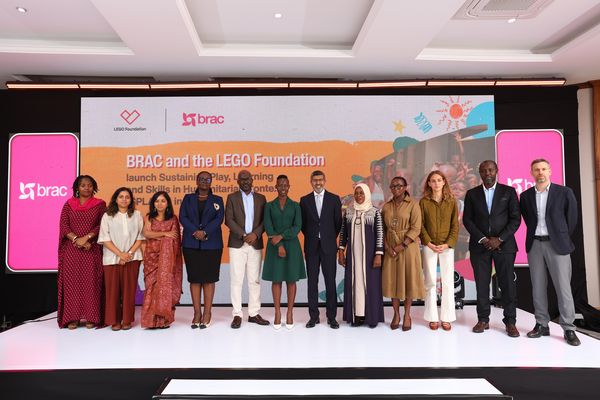
A new five-year partnership between BRAC and the LEGO Foundation builds on these experiences. Over the five years, the Sustaining Play, Learning and Skills in Humanitarian Contexts (SPLASH) project will support 400,000 children and adolescents in Bangladesh and Uganda.
In Uganda, the programming will bring together humanitarian play labs, responsive caregiving, and the two-generation approach, with a focus on strengthening support for children, caregivers and the systems around them.
The challenge is to ensure that these services continue beyond individual funding cycles. This requires sustained investment, stronger government systems and greater recognition of early childhood development in humanitarian funding and planning.
A play lab cannot solve the greater challenges faced by a displaced family. It cannot replace adequate nutrition, healthcare, protection or a stable home. But it can give a child a safe place, and to simply be a child.
Therefore, development partners, research institutions, civil society and the private sector need to work in collaboration with the government and communities to ensure that every child, no matter their circumstances, deserves the dignity of a childhood where they can learn, grow, and thrive.
Written by: Nazneen Jahan Mithun, Deputy Country Director, BRAC Uganda and Shituma Tajrin, Senior Manager, Programme Communications, BRAC International