In Uganda’s Amuru district, a great mango harvest isn’t always good news.
Here, mango orchards line the streets and homestead gardens. By the peak of summer, its yards fill with bright ripened mangoes. This marks the beginning of the mango sales season, a time of profits and bustling market places.
Not in Amuru, however. Year after year, it meant one thing for local farmers: watching tonnes of the fruit get spoiled before they could be sold. Unsold mangoes would be left to rot on the roadsides.
The local market in Amuru couldn't absorb the volume farmers were producing. There was no way to process, store, or sell the mangoes beyond the existing market. The next big markets were miles away, and farmers did not have the necessary connections or infrastructure required to export the fruit.
Rose Moyoo found a way to change it.
Seeing opportunity where others saw waste
Rose was a student at Gulu University, when she had the idea of starting an enterprise that would process the excess mangoes. The plan was simple: process mangoes into jam, with the goal to reduce food waste, extend the shelf-life of mangoes, give farmers a reliable place to sell their fruit, and create new jobs.
The enterprise, supported by Gulu University’s Incubation Hub, kicked off with a capital of UGX 350,000 (USD 95). Rose named it Rosalba EcoWave Company Limited.
Rose majored in agricultural entrepreneurship and communications. Her course work often took her to farming communities, where she saw firsthand how hardworking families lose out on income.
Her own path to being an entrepreneur is its own story of grit. Rose lost her father as a child. Her family sold firewood and charcoal for a living. Rose was only able to go to school when her family could set aside fees, which meant she was forced to take multiple breaks during the school year. Her family eventually moved her into a children’s home in Moyo, an hour away, from where she was able to attend school regularly. The regularity also improved her performance.
Rose went on to excel in college where she was recognised for her academic performance along with her commitment to community service. Rose got selected for the Mastercard Foundation Scholars Programme, implemented by BRAC, and received a scholarship to complete her A’levels.
The mango jam solving farmers’ challenges
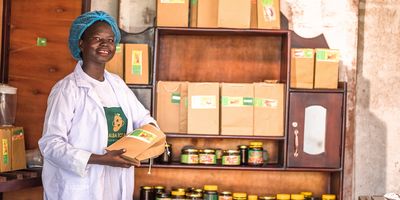
The early stages of her food enterprise saw a lot of experimentation – refining product quality, understanding consumers, and gradually creating a space in the local market. She went on to expand distribution networks through online platforms and forming partnerships with local shops.
Today, Rosalba EcoWave is valued at over 10x the initial investment, reaches over 1,000 households through customer and supplier outreach, and employs young people from the community. Farmers who once relied on informal, unpredictable markets now have a more stable channel for their mangoes, a supply chain that stretches from Amuru and Moyo to Juba in South Sudan.
While still modest in scale, Rose’s business contributes in significantly reducing post-harvest losses, extending the usability of seasonal produce, and creating stable income opportunities for the most vulnerable farmers.
Two years after she started the enterprise, in 2024, Rose joined the Scholars’ Transition Entrepreneurship Fund implemented by BRAC, and funded by the Mastercard Foundation.
As part of the programme’s long-term transformation, former scholars were further supported and Rose was among a number of scholars to receive a booster fund of USD 2,000 to expand their businesses. Rose took training on financial literacy, record keeping, and safeguarding, and improved her business management skills. With the booster fund, Rose now focused on new packaging and branding, and moved production from a home-based setup to a rented premises, to scale production.
She is currently building a mini processing facility to expand her production capacity.
About the Scholars’ Transition Entrepreneurship Fund
The Scholars' Transition Entrepreneurship Fund is a targeted initiative under the Mastercard Foundation Scholars Programme. It helps scholars and alumni turn social innovation and business ideas into reality through hands-on training, expert mentorship, and seed investment. BRAC is implementing the project in Uganda to improve economic independence and development for 200 alumni by nurturing their entrepreneurial spirit, upskilling as well as enhancing the ecosystem for innovative start-ups and growth of the existing businesses
The Mastercard Foundation Scholars Programme is a global initiative designed to develop the next generation of transformative leaders by enabling highly talented, service-oriented young people to pursue higher education and cultivate their leadership potential. Launched in 2012, the project was implemented by BRAC Uganda.
Written by: Barbra Ampaire, Communications & Public Relations Manager, BRAC Uganda
Edited by: Abida Rahman Chowdhury, Senior Manager, Content and Thought Leadership; Sameeha Suraiya Choudhury, Lead, Strategic Content; Syeda Tasnim Islam, Deputy Manager, Content and Knowledge Management