Simiyu is far, far away from Tanzania's main economic hub, Dar es Salaam. From the capital Dodoma, too, it takes nearly a day, give or take a few hours, to get there by road. The region lies on the doorsteps of the Serengeti, a landscape of vast rolling plains dotted with umbrella trees, kigelias, fig trees and baobabs, the majestic ‘tree of life’.
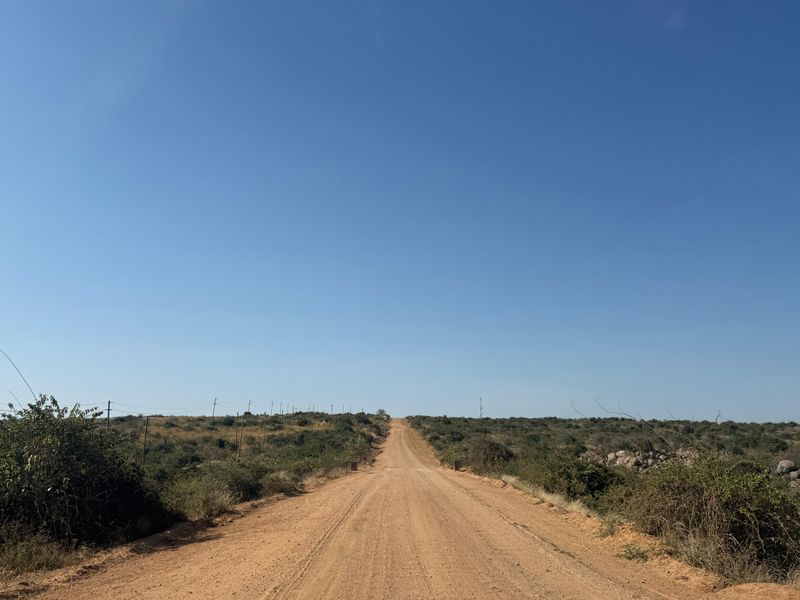
A glimpse of Simiyu, Tanzania, 2026. Photo by: Shituma Tajrin.
The remoteness does not just add to the scenery. It has become part of the problem. Homesteads are few and far between, village markets even fewer, and the main roads are mostly devoid of traffic, barring the occasional pickup truck, motorcycle, or bullock-drawn carts – still one of the most used modes of transport here.
Coupled with this, Tanzania is facing significant rain delays, signaling increasing climate instability across the country. The changes are already hurting farmers' livelihoods and could push 2.6 million more Tanzanians into poverty by 2050, according to the World Bank. Simiyu Region is prone to drought, and the seeds that farmers have relied on for generations are neither drought tolerant nor climate resilient.
Traditional knowledge served farmers well for generations, but it can’t keep up with a rapidly changing climate. Climate change has brought the crisis home, and smallholder farmers are the first to feel its effects. Meanwhile, income opportunities are precarious as well – many families farm on leased land, not owned, with limited access to financing, or modern agricultural know-how.
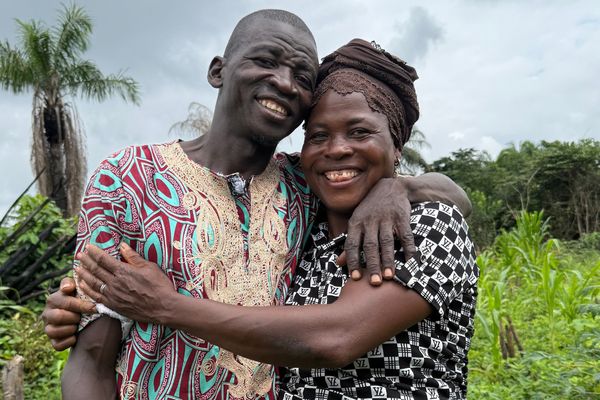
Deborah Kibaria has lived in Simiyu all her life. She and her husband grew cotton, maize, rice and sorghum. After he passed away, she was left with four daughters in school and four acres of land. The land should have been hers, but it is registered in her late husband’s name. Without full ownership, Deborah cannot plan for the future. Deborah’s case is just an example of one of the hardships that hundreds of farmers, especially women, face in the area.
It's in this region that a three-year food security and livelihoods project, Vijana Kilimo Biashara (VKB), is working with 15,000 smallholder farmers, especially women and youth, to improve food security and income. Our VKB systems change approach aimed to transform local markets into inclusive, climate-resilient systems by strengthening market linkages, services, incentives, and institutions beyond individual training and input support, enabling women, youth, and climate-vulnerable households to access sustainable, profitable livelihoods. The project strengthens value chains for two cash crops – sunflower and sorghum. It is not one fix but a chain of connected steps, each supporting the next.
It starts with farmer groups. Farmers share labour at harvest, share knowledge and support each other.
Another farmer in the same project, Emmanuel, is a lead in a group of 11. He left school to begin farming at 18, working other people’s land before leasing his own. In 2024, he joined VKB, and part of his leased land is now a demonstration plot.
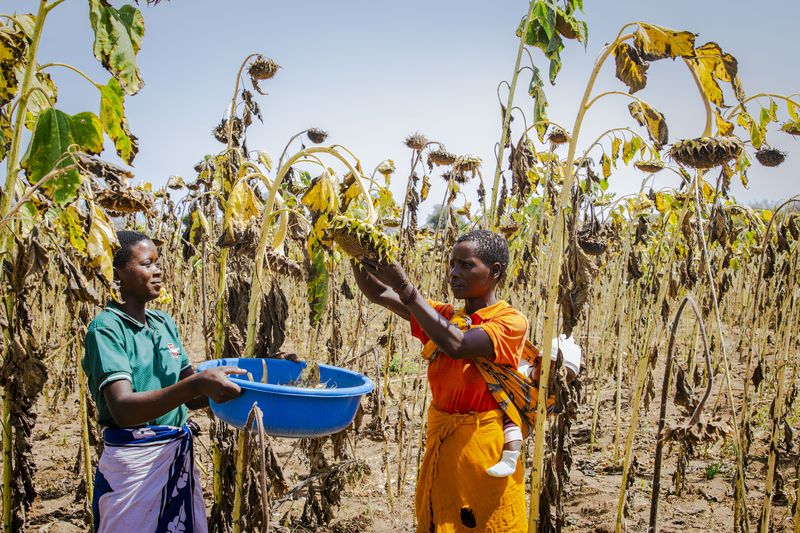
Farmers collect ripe sunflowers by cutting the flower head from the stalk, Tanzania, 2026. Photo by: Daud Mohamed.
The project links farmers with improved, climate-resilient seeds. In climate-affected areas, the VKB promotes climate-informed livelihood choices, strengthening resilient agricultural value chains, improving access to finance and advisory services, and enabling stronger connections between producers, private-sector actors, buyers, and government institutions.
Many, like Deborah and Emmanuel, once scattered seeds by hand, only to remove the excess growth, resulting in crop loss. Now 400 farmers have been linked with suppliers for tools such as hand-pushed planters, which cut planting time from a full day to just two hours.
Emmanuel switched to a new sunflower variety with higher oil content, and now plants in neat lines. Each line yields 44 kg of seed, up from 14 kg. On one acre, that means about 1,400 kg instead of 400 to 600 kg previously.
Farmers have also tested this for themselves. One farmer planted three sunflower varieties side by side, using the same land and the same amount of seed. Below is what the farmer has reported from the trial:
| Seed type | Yield per acre | Seed cost |
|---|---|---|
| Local | ~180 kg | n/a |
| Government-improved | ~480 kg | 8,000 TZS |
| Climate-resilient | ~540 kg | 50,000 TZS |
The climate-resilient seed costs 42,000 TZS more, but the extra harvest was worth about 60,000 TZS. That left the farmer 18,000 TZS better off. As tested, the pricier seed was seen to pay for itself.
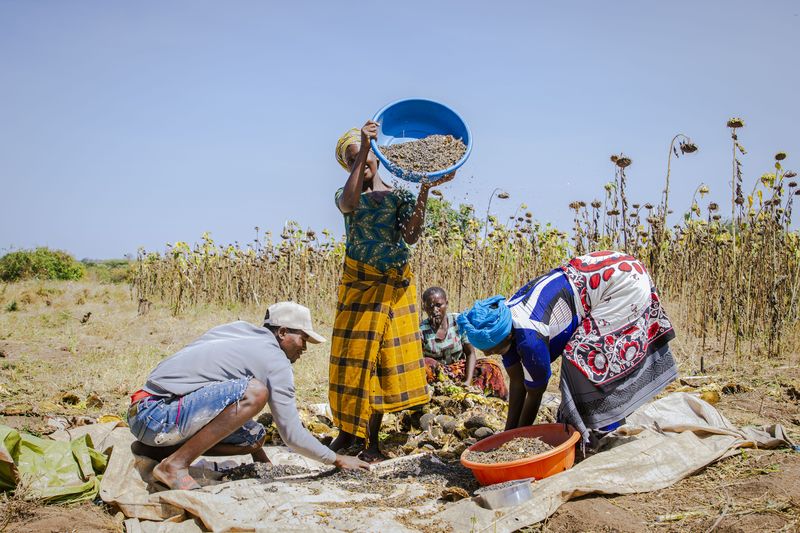
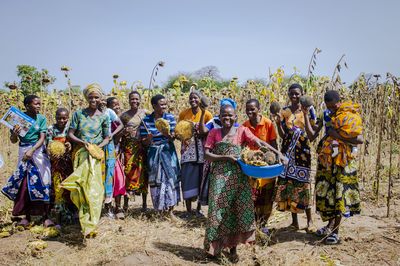
A farmers group harvesting sunflower seeds, Tanzania, 2026. Photo by: Daud Mohamed.
Linking sellers to buyers
Once harvested, sunflowers no longer have to travel far. Each village has a collection point, and there are two aggregation centres where farmers can drop off produce. Local collectors, known as rikari, also visit farms to pick up sunflowers.
From there, produce goes to buyers who press the seed into edible oil. The improved seed helps here too: a 65 kg bag now produces 20 litres of oil, up from 17. Farmers are connected directly to these buyers, which cuts out costly middlemen. Emmanuel’s group is already planning to press its own oil rather than selling only raw seed.
Places like Simiyu are often bypassed by agricultural development. Left alone, farmers carry the full weight of climate risk, unfair prices and lack of information. They plant seeds that cannot survive a bad season, sell with no bargaining power, and lose crops to pests and poor storage.
The VKB project is changing that with seed access, training, collection points and direct market links.
Hassan Kiseto, District Agriculture, Livestock and Fisheries Officer, has been closely associated with the project. He attended farmers day, group meetings, visited crop lands, and sat with the seed companies. He shared, “The numbers may be small but the impact is big. When the project is phased out, we will continue to do what the project has been doing. It helps strengthen what the government is trying to achieve, and we want to sustain a good process.”
Emmanuel, who left school early and farms leased land, has more than doubled his yield. His group is now looking at oil production. Deborah’s story shows how far there is still to go. Until the land she farms is legally hers, she cannot plan for tomorrow.
No single project can fix everything. But VKB shows where change can begin: seed that survives a dry season, a buyer within reach, and a fair price for the work. For the farmers of Simiyu, that is what a fair chance looks like.
Written by: Abida Rahman Chowdhury, Senior Manager, Content and Thought Leadership and Shituma Tajrin, Senior Manager, Programme Communications, BRAC International
Edited by: Sameeha Suraiya Choudhury, Lead, Strategic Content, BRAC International
Photo Credit: Daud Mohamed, Senior Communications Officer, BRAC Maendeleo Tanzania and Shituma Tajrin, Senior Manager, Programme Communications, BRAC International