“I had to drop out of school at 18 when I became pregnant with my son, Byishimo, who is now five years old. I do not want much, but I do want him to finish his education, and get the opportunities that every child should get," says 23-year-old Colette Niyonsenga from Huye, Rwanda.
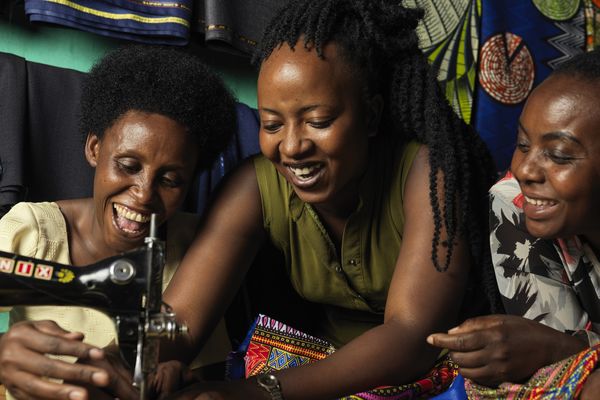
Today, Colette runs a tailoring training centre reaching young women in her community who want to pick up functional skills for an income. “The training centre allows me to pay for my son’s school fees and contribute to my family,” she shares.
Colette often wishes this support was there when she had to drop out of school, a wish that led her to where she is now.
Huye district, in the southern province of Rwanda where Colette lives, is a three hour drive away from the capital, Kigali. The district lags behind significantly when it comes to livelihood opportunities – the choices remain limited to small-scale farming and traditional agriculture practices.
The Rwandan government’s district development strategy 2018-2024 outlines that although Huye district has a considerably high rate of employment compared to other districts outside the capital, statistics show that most of the population is involved in the informal sector. This means, income is not stable, and liveable wages are not guaranteed.
For Colette, the challenges were manifold. “Raising a child when I was so young myself was not easy. For a while, I was alone, and I had no one to guide or support me, nor did I have a reliable income. My partner eventually stepped up and took on the responsibilities of parenthood with me, but those early days were incredibly hard.”
Research by the National Institute of Statistics Rwanda shows that the gender disparity in employment is still notable in the country. Near the end of 2025, the gender gap in labour force participation rate was approximately 16.2% lower for women than men. This means that for every 100 men employed, only 84 women are in employment. It is important to note that this number only accounts for women who are in the formal sector, and women who are in urban areas.
Young mothers are an especially vulnerable group — they are significantly more likely to drop out of school, lose access to safe and supportive environments, and face increased risk of long-term poverty.
Two years back Colette joined a youth club, which is part of The Mastercard Foundation Accelerating Impact for Young Women in partnership with BRAC programme. It is equipping 1.2 million adolescent girls and young women in 6 countries across Africa, with age-appropriate entrepreneurship, employability, and life-skills training, as well as the tools to start and scale their own businesses. Girls and young women attend sessions at mentor-led clubs, located close to their homes, where they learn about their sexual health and reproductive rights, business and life skills, and eventually go on to pursue their own livelihoods. Some choose tailoring, others go for agriculture, while some pursue small businesses of their choosing.
“Learning a skill, and giving it back to other young girls who are in the position I once was gives me so much joy. I know how hard it is for young women to pursue a business, and how intense the need to provide is once they have a family.”
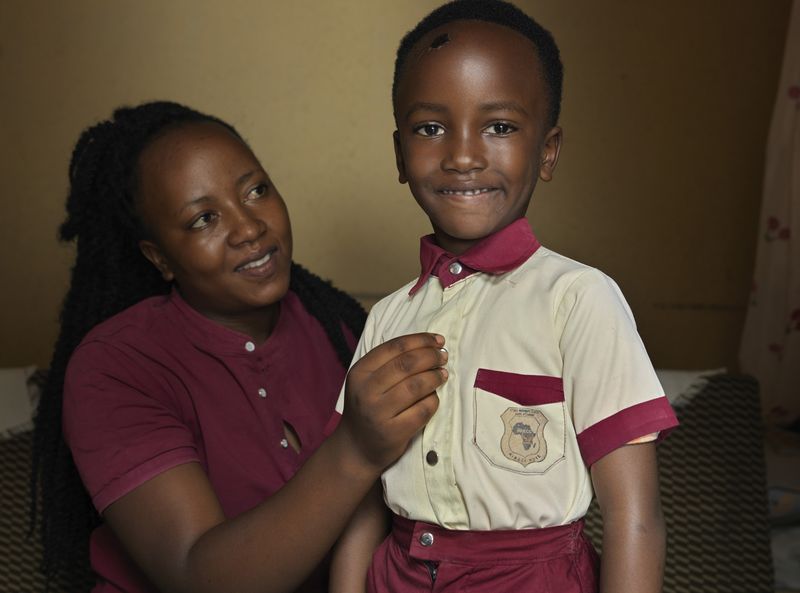
Colette and her son, Byishimo. Photo: Peter Caton, 2025.
For Colette, education is key, even if her own journey was cut short. “I want my son, and the girls I train, to believe they can choose their own futures.”
By Odila Umuziranenge, Regional Manager, AIM Programme, Nyanza region and Syeda Tasnim Islam, Deputy Manager, Communications, BRAC International