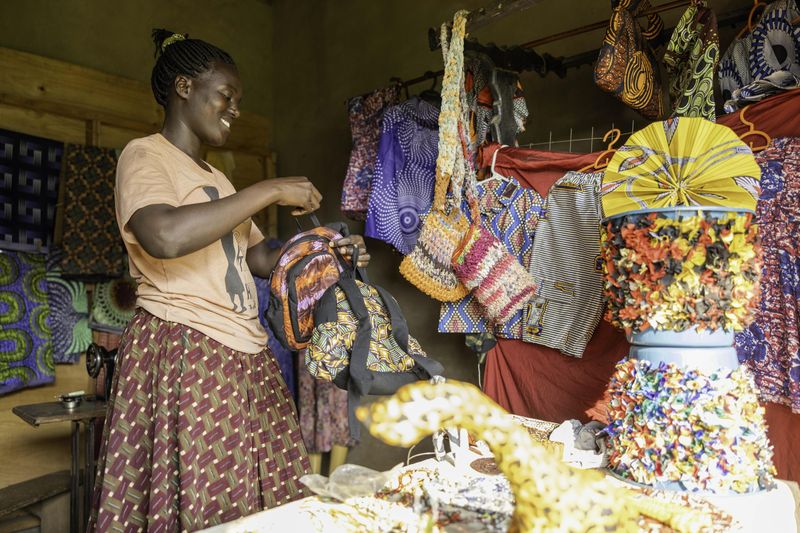
Sarah Ntale hangs a colourful backpack at her shop, which she made herself. Photo: Zahara June, Uganda, 2024.
In communities across Africa where we work, digital access is reshaping the lives of women who have traditionally been underserved. Take for instance Sarah Ntale from Iganga in Uganda, a district almost two hours away from the capital Kampala. She could not finish school and studied until Senior 4. Today, she has her own store selling handicrafts, handmade outfits, and upcycled products, in her hometown. Sarah’s business is growing, she is saving and both her kids are now in school. What made it possible? A simple mobile phone.
Sarah was a member of a BRAC youth club in her community. At the club, she built life skills and learned to better manage her small business and finances. She also discovered how to use social media to learn to make new products and reach new customers. She quickly became tech-savvy, using Instagram, Tiktok and Facebook, to expand her business. When she found YouTube tutorials on DIY handicrafts, Sarah was hooked. She started making new products, adding her unique touch, bringing bits of Kampala-style into Iganga. Sarah’s grit, her mother and family’s support helped Sarah get where she is. However, the one thing that gave her an edge over many others was her smartphone – she was one of very few in the club who had one.
According to a survey by the World Wide Web Foundation conducted in 2020, in Uganda women are 43% less likely than men to have basic internet access. Almost 10,000 women and men across four countries were surveyed — Colombia, Ghana, Indonesia and Uganda — to find out whether and how they use the internet, and their experiences using the internet. While Uganda fared better than the broader African average, it reported the highest gender gap among the countries surveyed.
This divide comes with a steep price. In 2020 alone, the Alliance for Affordable Internet estimated that, in 32 low and middle-income countries, the gender gap in internet use resulted in losses of $126 billion in Gross Domestic Product (GDP) for all nations combined.
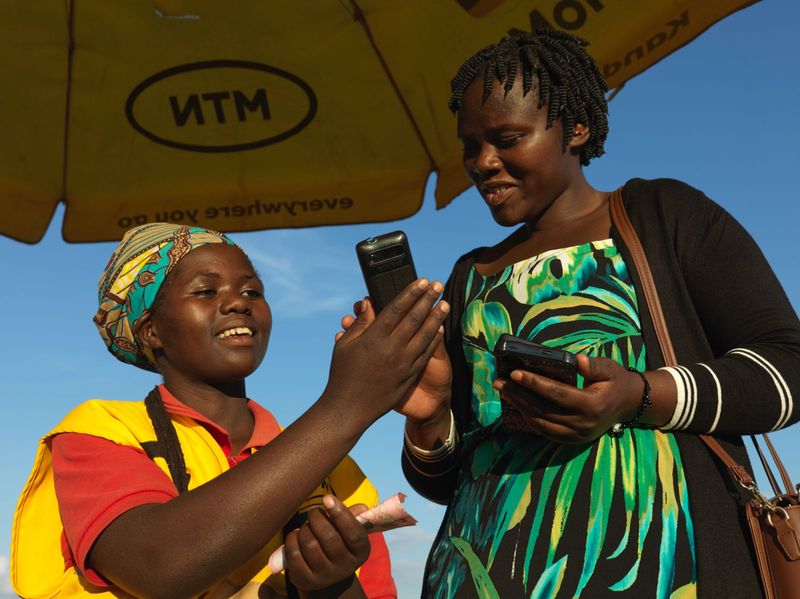
Angelique Dusabimana assists a customer with a mobile money transfer. Photo: Peter Caton, Rwanda, 2025.
A smartphone helped turn Sarah’s curiosity into marketable skills. However, the digital space is not without risks. In fact, digital violence is spreading at alarming speed without effective laws and accountability. What checks and balances need to be in place to make sure the digital space does not become yet another tool for violence against women?
Digital literacy is not optional anymore. There is an insidious threat emerging alongside digital expansion with no guardrails in place: the rise of digital violence, especially against women.
In 2024, UN Women reported that technology-facilitated violence against women and girls has been intensifying and studies show 16 to 58% of women worldwide have been impacted by some form of digital violence. Meanwhile, another study conducted by Columbia University reveals that women who use digital financial services in Africa and South Asia face a greater risk of cyber-fraud compared to their male counterparts, especially in relation to social-engineering-scams like SMS and voice phishing.
Research indicates that women face a significantly higher likelihood of identity theft, being twice as vulnerable compared to men, and are also at an increased risk of experiencing online harassment.
In 2023, our microfinance programme in Africa introduced a six-month financial and digital literacy training for women clients. The training focused on building financial and digital skills and confidence, business development, and overall wellbeing.
The impact of the training is already visible. You will find them in stories of people like Angelique Dusabimana from Rwanda. In addition to farming, Angelique is also a licensed MTN Rwandacell Plc mobile money agent. Her awareness regarding financial and digital scams gave her the confidence to apply and get her license. She has a small kiosk in her community, offering mobile money services such as sending and receiving money, paying bills, and buying airtime. This is a second source of income for Angelique, something that allows her to save and plan for the future, especially for her daughter.
The future is here and it needs systems that ensure technology comes with protection, context, and knowledge.
- Scams used by criminals to exploit a person's trust in order to obtain money directly or obtain confidential information to enable a subsequent crime
- Fraudulent phone calls or voice messages designed to trick victims into providing sensitive information, like login credentials, credit card numbers, or bank details.
The 16 Days of Activism is a global call to prevent and eliminate violence against women and girls. This year, the UN Women's theme urges us to build a world where technology becomes a catalyst for equality. At BRAC, we recognise that digital spaces must be safe, accessible, and empowering for every woman and girl. Through our community-driven approach, we continue to champion solutions that protect rights, expand opportunities, and ensure that no one is left behind in an increasingly digital world.
Written by: Nazifa Raidah, Deputy Manager, Events and Campaigns.
Featured
Mastercard Foundation and BRAC expand landmark partnership to unlock pathways to dignified and fulfilling work for 2 million young women across Africa
A three-point plan to tap into one of the world’s largest growth opportunities – women!