The Mastercard Foundation and BRAC International have announced a major expansion of their long-term Accelerating Impact for Young Women (AIM) programme. By 2033, AIM will empower 2 million adolescent girls and young women across seven African countries with the skills, confidence, and resources they need to shape their futures and strengthen their communities.
Since its inception in 2021, the AIM programme has engaged over 382,000 girls and women through more than 2,800 youth clubs and more than 18,000 microfinance groups, providing age-appropriate training in entrepreneurship, employability and life skills, along with the tools to start and grow their own businesses. This expansion also aligns with the Mastercard Foundation’s Young Africa Works strategy, which aims to enable 30 million young people across the continent to access dignified and fulfilling work. This new phase builds on this strong foundation, targeting an additional 1.62 million adolescent girls and young women across Ghana, Kenya, Liberia, Rwanda, Sierra Leone, Tanzania, and Uganda.
“This partnership between the Mastercard Foundation and BRAC is a testament to the longstanding trust and collaboration our organisations have built over decades,” said Shameran Abed, Executive Director of BRAC International. “We know that lasting change is only possible when women are empowered to realise their full potential. Grounded in robust evidence from our youth programmes and poverty alleviation work, the expanded AIM programme enables us to scale what works – delivering meaningful, sustained impact rather than piecemeal solutions.”
Adolescent girls and young women living in poverty are often excluded from education, skills training, and dignified work. Many also face early motherhood, limited mobility, safety risks, restricted access to capital, and social norms that hinder their economic participation. Through its holistic approach and strong community engagement, AIM promotes both social and economic empowerment. The scale-up expands the programme’s reach to even more of those most often left behind.
“Girls and young women have immense potential, yet they remain among the most excluded from education, skills training, and dignified work opportunities,” said Sewit Ahderom, President and CEO of the Mastercard Foundation. “AIM is changing that. I’ve seen how it transforms confidence, expands their sense of possibility and sustains pathways to education and economic opportunities for those who need it most. It also ensures millions more young women can access the skills and opportunities they need to build fulfilling lives, lift their families, and lead change in their communities.”
Drawing lessons from its initial phase, the redesigned AIM programme will prioritise access to quality education, as well as expand opportunities for skills development, paid employment, and entrepreneurship. The long-term support provided under AIM will enable participants to transition into jobs or establish their own livelihoods. The programme will also work with families and communities to create a more enabling environment for adolescent girls and young women.
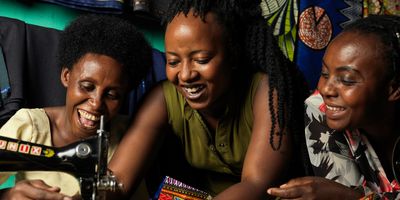
23-year-old Colette from Rwanda’s Southern Province, is one of thousands of adolescent girls and young women who have experienced the transformative potential of the AIM programme’s youth clubs. “I dropped out of school at 18 because I was pregnant. Raising a child at such a young age was not easy, and I had no one to guide or support me. What truly changed my life was learning essential life skills. My club mentor helped me recognise my potential – what I am truly capable of. I learned about saving, managing money, and running a business, and received start-up capital to get started. I began by buying and selling kitenge fabric, which enabled me to buy a sewing machine and open my training centre.”
AIM’s anticipated impact:
- Support 400,000 girls with education support and impact 1.4 million students
- Work with 2,000 schools to improve learning environments
- Support 620,000 adolescent girls and young women through livelihoods pathway and 580,000 young women to engage with microfinance. In total, 1.2 million adolescent girls and young women will benefit from sustainable livelihoods, enabling a transition into dignified and fulfilling work
- Impact 6.4 million people in the communities we support