According to the Asian Development Bank (ADB), 135 million people across the Asia-Pacific region live in extreme poverty. About 700 million more live in extreme poverty beyond it. To explore collaborative pathways to strengthen poverty reduction systems, ADB convened nearly 500 government leaders, policymakers, practitioners, development partners, and innovators at its third Asia-Pacific Social Protection (APSP) Forum in Manila.
As Rohini Pande, Henry J. Heinz II Professor of Economics at Yale University, said during the APSP forum, people need “more than cash to climb out of poverty sustainably”.
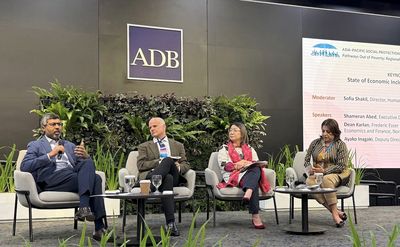
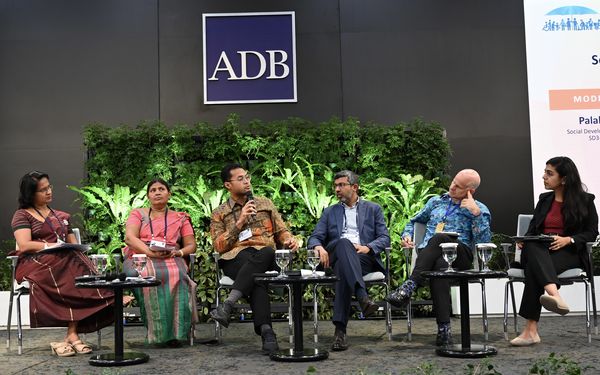
We have more than enough evidence to know what works for extreme poverty reduction: a package of interventions that together tackle the multiple constraints trapping people in deep poverty (otherwise known as the Graduation approach). The question we need to focus on now is how to scale proven approaches like Graduation while preserving quality and continuing to strengthen cost-effectiveness. This was the focus of the APSP panel ‘Scaling Economic Inclusion: Pathways out of Poverty through Social Protection Systems’, which Shameran Abed, Executive Director of BRAC International, joined on day 2 of the forum.
If we are to achieve lasting impact for the millions of people living in extreme poverty across Asia and Africa, governments must be at the centre, Abed stressed. Addressing an issue of this magnitude is beyond the capacity of civil society alone, he continued.
While civil society can design high-quality programmes that drive impact and support ongoing innovation to improve overall effectiveness, only governments have the building blocks needed to reach people at this scale.
Governments already hold most of the essential pieces
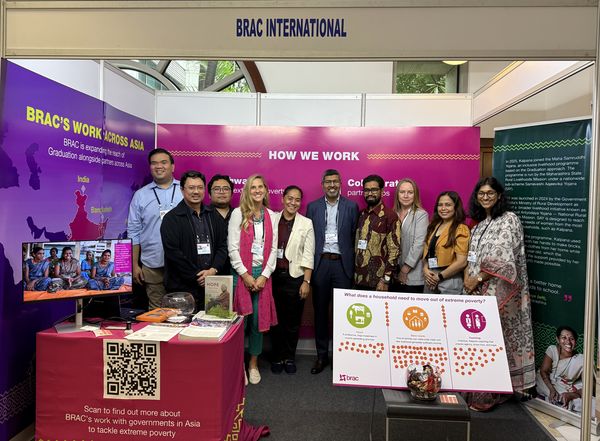
Many countries grappling with extreme poverty, including countries where BRAC works such as India, Indonesia, and the Philippines, are already investing in many of the key ingredients for an evidence-backed Graduation package. These include providing a productive asset to generate income through livelihoods or employment programmes and meeting basic needs through social protection programmes. However, as Abed noted, these interventions are not always delivered as a well-sequenced package, which is critical.
Rigorous evidence shows the Graduation approach can achieve broad and lasting impact across various contexts, including lasting improvements in income, savings, consumption, and overall well-being. Dean Karlan, keynote speaker at the Regional Forum and APSP panelist, has contributed significantly to such findings and shared highlights from a recent meta-analysis of Graduation during the forum. Karlan is also Frederic Esser Nemmers Distinguished Professor of Economics and Finance at Northwestern University’s Kellogg School of Management and Co-Founder of Innovations for Poverty Action.
“Social assistance is temporary. Empowerment is forever,” emphasised APSP panelist Dinar Dana Kharisma, Director of Social and Economic Independence, Ministry of National Development Planning of the Government of Indonesia, in a panel alongside Abed and Karlan. Providing people with training and support to generate income through productive livelihoods, he continued, contributes to more lasting impact and poverty reduction, as shown by the evidence on Graduation. The Government of Indonesia is seeking ways to integrate the Graduation approach into existing schemes for this very reason, which BRAC is supporting as a technical partner and through coordination support (more on this below).
Scale what works through governments and help them do it well
“The future of Graduation at scale is government-led, but that does not mean government alone,” said Abed during the panel. We must support governments in designing and delivering high-quality Graduation programmes at scale. This is where civil society, multilateral organisations, and philanthropic partners come in.
Together, we need to help governments:
- Make use of what they have already invested in, like social protection systems, rather than operating as separate programmes.
- Integrate what evidence shows is necessary to achieve long-term impact but currently is missing, and tailor interventions to the constraints households actually face.
- Facilitate coordination to ensure interventions are delivered effectively and connected to markets, skills, and employment, so participants can access more productive economic opportunities.
- Build monitoring and learning into programmes from the outset to inform continued iteration and improvements.
- Invest in frontline capacity to help households build savings, diversify their livelihoods, and withstand increasingly frequent shocks.
- Explore ways digital technology can strengthen targeting, payments, monitoring, and case management while remaining human-centred.
- Protect quality as programmes are scaled up.
Partnerships across Asia demonstrate how this can work
In the Philippines, BRAC is partnering with the Department of Labor and Employment (DOLE) to integrate the Graduation approach into its Integrated Livelihood Program. The partnership builds on a pilot implemented between 2018 and 2020 that demonstrated measurable improvements in participants' incomes and self-reliance. An independent evaluation by Innovations for Poverty Action showed that participants experienced an 8-9% increase in monthly per capita consumption, a 19-43% increase in the value of productive assets, and a 53-104% increase in savings, alongside sustained improvements in resilience.
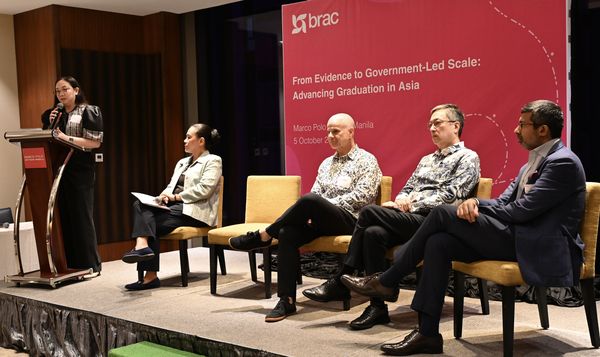
Rather than building a separate programme, the focus is on strengthening an existing government initiative. This includes improving coaching and mentoring, working more closely with local governments and other partners, and exploring how technology can support programme delivery and monitoring. Atty. Julie Ann Chang-Lim, Assistant Secretary of DOLE shared these points in her remarks at BRAC’s reception, “From Evidence to Government-Led Scale: Advancing Graduation in Asia,” held after the APSP Regional Forum.
In Indonesia, BRAC is working with the Ministry of Social Affairs to align its national Socio-Economic Empowerment Program more closely with the Graduation approach.
The programme aims to reach 165,000 families in 2026, with the potential to more than double this number in 2027. The opportunity is not only to expand coverage but also to ensure that families receive support that helps them achieve more lasting economic progress.
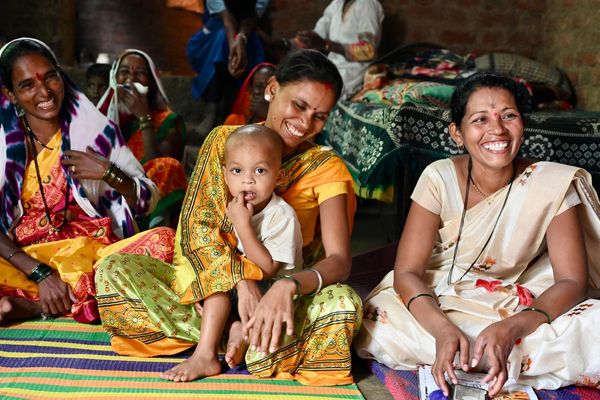
In India, BRAC is working with national and state governments to adapt, enhance, and scale a high-quality Graduation model within existing public systems, including the nationwide programme Sameveshi Aajeevika Yojana, which is designed to reach women from the most vulnerable households and meet their needs.
While each country has its own context and systems, the principle is the same: build on what governments already have, strengthen what is missing, and focus on delivering lasting results. Across these three countries, and beyond in Africa, BRAC is committed to ensuring its government partners have the resources and tools needed to build on existing systems and achieve greater, more sustainable impact for those further behind and often missed by existing schemes.
“Our job today is no longer to show that Graduation works”, Abed said at APSP. We have extensive evidence to prove it does. Our job today is to work together to build public institutions, financing, and learning systems that enable governments to scale Graduation while preserving quality so hundreds of millions of people around the world can build sustainable pathways out of poverty.
--