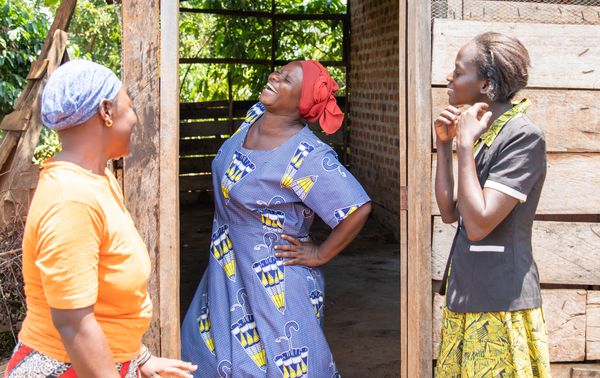
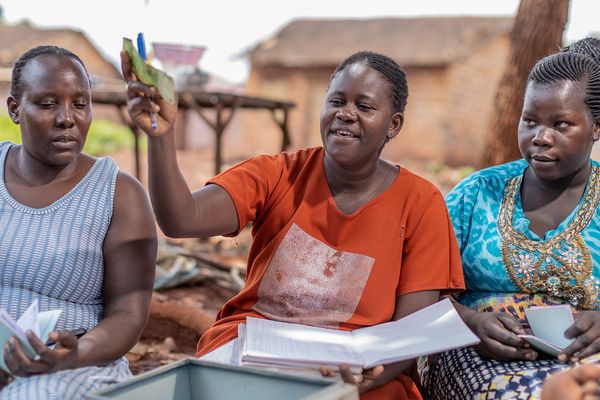
In March of 2024, three women decided to participate in a new livelihood and social empowerment programme that was coming to their village. Mutesi Abiba (28), Namulondo Joweria (25), and Nangobi Benah (35) — are all women who dropped out of school early, got married early, and had children early. They did not have any income of their own. Living in an area where setting up a business, let alone expanding one, is challenging, the women saw an opportunity, and took it.
Today, they are business owners who have successfully cleared out their inventory, and already diversified their businesses with projected profits triple the amount they made in their first month. All this was achieved within just two months of operating.
So, how does one build a business from scratch and make it successful? Let’s learn from the businesswomen of Bufaki village in Uganda.
Mutesi Abiba, Namulondo Joweria, and Nangobi Benah live in Bufaki village in Uganda’s Kamuli. The district is located in the eastern region of Uganda, neighbouring Jinja— a city known for being located at the “source of The Nile”. Kamuli is bursting with life— evident in the beautiful expanse of its grasslands and gently sloping hills, contrasted by the roadside bars, vibrant fruit stalls, and the floating aroma of “street chicken” — skewered, roasted chicken wings on a stick, sold by hawkers that pour in during slow moving traffic.
Unlike Kamuli town, Bufaki is quieter. It takes 40 minutes on a boda-boda (Uganda’s widely used motorcycle taxis) on dirt roads to get to Bufaki. Schools are few and far in between, the nearest clinic is a 30-minute motorcycle ride, and most people rely on very little income due to a lack of business know-how, demand, and access.
Before the three were the savvy business-women they are today, Abiba, Joweria, and Benah had to depend on their husbands for everything. Stretching an already limited amount of income to meet growing expenses of both the household necessities and children's education meant forgoing other needs. These “other needs” were not recreational, but basics like affording nutritious meals, having the means to save for their children’s future, or even leftover funds for emergencies.
The three women are no stranger to such constraints. Growing up, they all had to give up something. Abiba and Benah had to drop out before completing primary school. Joweria could only continue her education till the secondary level.
Early last year, one of the elderly women leaders in their village informed them of a programme that supports young women with the tools they need to uplift themselves and gain financial independence.
The Mastercard Foundation Accelerating Impact for Young Women (AIM) in partnership with BRAC equips adolescent girls and young women with age-appropriate entrepreneurship, employability, and life-skills training, as well as the tools to start and scale their own businesses.
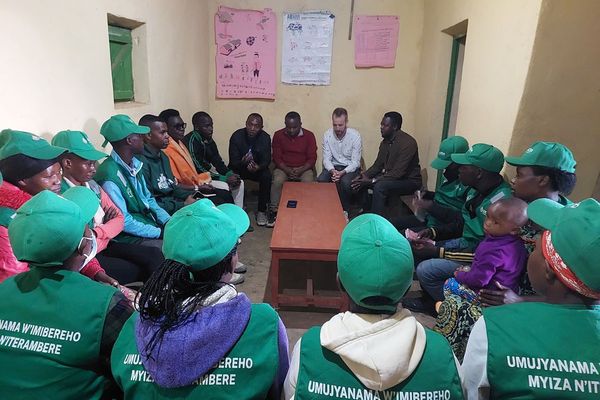
Before receiving livelihood support, groups of young women and girls attend club sessions together. They have confidence-building sessions, and learn of ways they can advocate for themselves in both public and professional settings. Eventually, this community of girls and young women form savings groups, learning the ins and outs of loans, saving, and investing. Through this experience, young women and girls also learn financial bookkeeping, financial discipline, and in most cases, get connected to formal banking services for the first time ever.
After receiving business training, developing a detailed business plan, and getting a start-up capital fund from AIM— the women started their very own poultry farming business. Between April to June of 2025, they tripled their inventory, expanded their business, and have developed a strong relationship with a number of clients. They are also expecting to earn a profit triple the amount they earned in the first month. When asked how they did it, they shared the insights any young entrepreneur could use to build a successful business from the ground up:
Lesson 1: Knowing your market is as essential as knowing yourself
“Initially, we planned to open a gnut (groundnut) milling business. It is a staple condiment in Ugandan cuisine, so we thought selling and milling the paste would be a good idea.”, shares Joweria. Abiba chimes in, “But as soon as we learned of the government’s decision to ban gnut milling, we had to change our plans.”
Abiba continues, “It was challenging to come up with a different business idea. In our village, people are daily wage earners who mostly only purchase essential household items— but that too, in limited quantities.”
Benah adds, “One of the first things we learned during our training was understanding if people would actually want to buy what we are selling. Street chicken is a popular street food sold year-round, especially in town areas. Luckily, we were all experienced with farming and all three of us had individually trained on poultry farming before BRAC—so we thought, why not just open up a poultry business, and supply to our local street chicken hawkers?”

Abiba, Joweria, and Benah tending to their chickens. Photo: Twal Photography, Uganda, 2025.
Lesson 2: Choose your partners wisely
“We all knew each other as neighbours in this village. We were already acquainted with each other, meeting during gatherings or at festivals”, Abiba says, “but our club sessions and experience in the savings group brought us closer.”
Joweria shares, “We thought that if we joined together, our business would be more profitable than if we were doing this alone. We also figured out our strengths. Abiba is great with people so she is the Chairperson, I took on the Secretary role because I like organising; I ensure our operations run smoothly, Benah took an interest in bookkeeping during our training so she is the Treasurer.”
Lesson 3: Create a detailed business plan; win investors
“Once we decided on the business idea, we got support from AIM to draft a business plan. They gave us the document and helped us navigate through the paperwork. We provided our personal information and bank details, the purpose of our business, the capital we are investing, the division of profit, and the roles each of us were going to take on”, says Abiba.
Abiba continues, “Eventually, we received a start-up fund from AIM, filled up a business registration form that they gave us, and registered our business. That day, we all celebrated— this was the first time we became official business owners!”
Lesson 4: Use the capital for a boost
“Using some of the start-up capital we received from AIM, we bought 100 broiler chickens with UGX 320,000 (USD 89). Then, the programme guided us through buying chicken feed, brooders, as well as the drinkers and feeders”, explains Benah, “I kept a record of every expense we made. We wanted to take care of our chickens, and ensure quality.”
Lesson 5: Prioritise your customers; make lasting relationships
“A big part of our training included treating our customers well, and being friendly. We learned that we should be open and interact with people, and spread the word about our products”, says Joweria. She adds— “We would attend local trading shows and talk to the street chicken sellers. By the time the chickens were three weeks old, we already had a few willing buyers. We started selling from home and at trading centres.”
Lesson 6: Have a scale-up mindset
“The sales from our first batch of birds gave us around UGX 1,300,000 (USD 363.36)”, Abiba says, adding— “we realised we couldn’t just depend on poultry farming. So we decided to buy three pigs from the profit.”
Benah shares, “We also bought more chicken and pig feed, and other necessary items. With the money that was leftover, we pooled in some of our individual incomes, and placed an order for 300 chickens. This time, we are planning to sell eggs.”
Joweria adds, “Fortunately, the share-outs from our savings group and earnings from the business helped us set something up of our own as well. I provide mobile money services, Abiba sells petrol, and Benah has her own snack business. I no longer have to depend on my husband.”
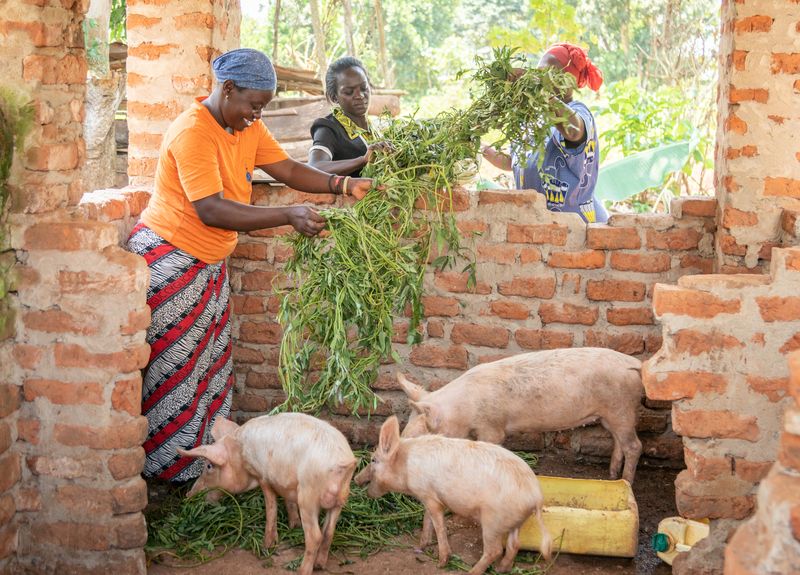
Abiba, Joweria, and Benah feeding their pigs. Photo: Twal Photography, Uganda, 2025
Lesson 7: Protect your profits; grow yourself
“I’ve learned that business money is not my money. Now I don’t let people borrow from it—it’s for growing the business,” Abiba shares, when asked what entrepreneurship has taught them.
Joweria adds, “I talk to people a lot more than I used to. I have to interact with our buyers and potential buyers often, so I am a lot more friendly and open now.”
Benah replies, “I learned customer service and that business money is separate from personal money. Whatever we earn in profits, we reinvest into the business to make it grow. We are hoping to earn UGX 3,900,000 (USD 1086) this month.”
Beyond meeting needs
When asked how their livelihoods have impacted their lives on a personal level— the women shared that they can now send their children to school and can pay for their day-to-day needs.
“I can also buy the shoes that I want," said Joweria.
By Syeda Tasnim Islam, Deputy Manager, BRAC International, and Barbra Ampaire, Communications Officer, BRAC Uganda
Featured
Mastercard Foundation and BRAC expand landmark partnership to unlock pathways to dignified and fulfilling work for 2 million young women across Africa
A three-point plan to tap into one of the world’s largest growth opportunities – women!